|
The apparent reason for the formation of a neutron halo is simple and can be understood
in terms of a potential model. Let us assume that a nucleus has a neutron loosely bound to
an inert core. We further introduce the simplification that the interaction potential between
the neutron and the core is a square well, the size of which is that of the core nucleus itself.
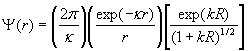
The wavefunction of the neutron outside the potential is written as
where R is the width of the potential. Using this wavefunction, the density distribution of the neutron is written as
The size is
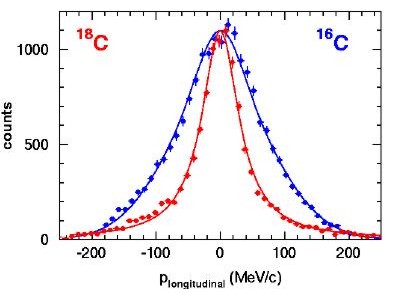
reflected in large nucleon removal cross sections and narrow momentum
distributions. Since tunnelling is a purely quantum mechanical
phenomenon, the halo has no classical analogy [1].
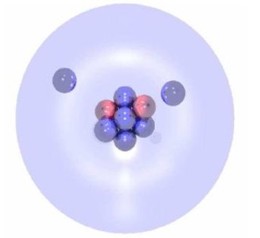 
The parameter k, which determines the slope of density tail, is related to a separation energy of the neutron (ES) by
where μ is the effective mass of the system. As can be seen from these equations, when
Es decreases κ becomes smaller and thus, the tail of the distribution becomes longer.
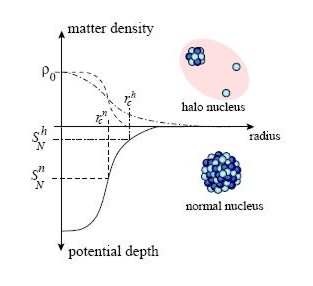 
Although the surface diffuseness is known to be equal for all stable nuclei, that constancy
is now understood simply as a reflection of the nearly-constant nucleon separation energy
(6-8 MeV) for stable nuclei. In fact, the asymptotic slope of the density distribution of stable
nuclei is consistent with the slope calculated by above mentioned equation. In general, the surface diffuseness
is expected to depend on the nucleon separation energy. The neutron halo is the most
pronounced case for a small separation energy (< 1 MeV).
The momentum distribution [f(pi)] of the neutron is expressed by the Fourier transform
of the wavefunction

[1]
K. Markenroth, Exploring the Exotic: Experimental investigations far
from stability,Department of Experimental Physics Chalmers University
of Technologyand Göteborg University Göteborg, Sweden, 2001
[2] I.Tanihata, Neutron halo nuclei, J. Phys. G: Nucl. Part. Phys. 22 (1996) 157-198. Printed in the UK
|