


Single Photons from Two-Dimensional ZnPS₃ – An Important Step for Quantum Technologies
2026-06-30
Scientists from the Faculty of Physics at the University of Warsaw, in collaboration with teams from the National University of Singapore and Radboud University in Netherlands, have observed single photon emission from layered two-dimensional material ZnPS3. This discovery represents a crucial step toward establishing low dimensional materials as a versatile platform for quantum information science. The research findings were published in the prestigious journal “ACS Nano”.

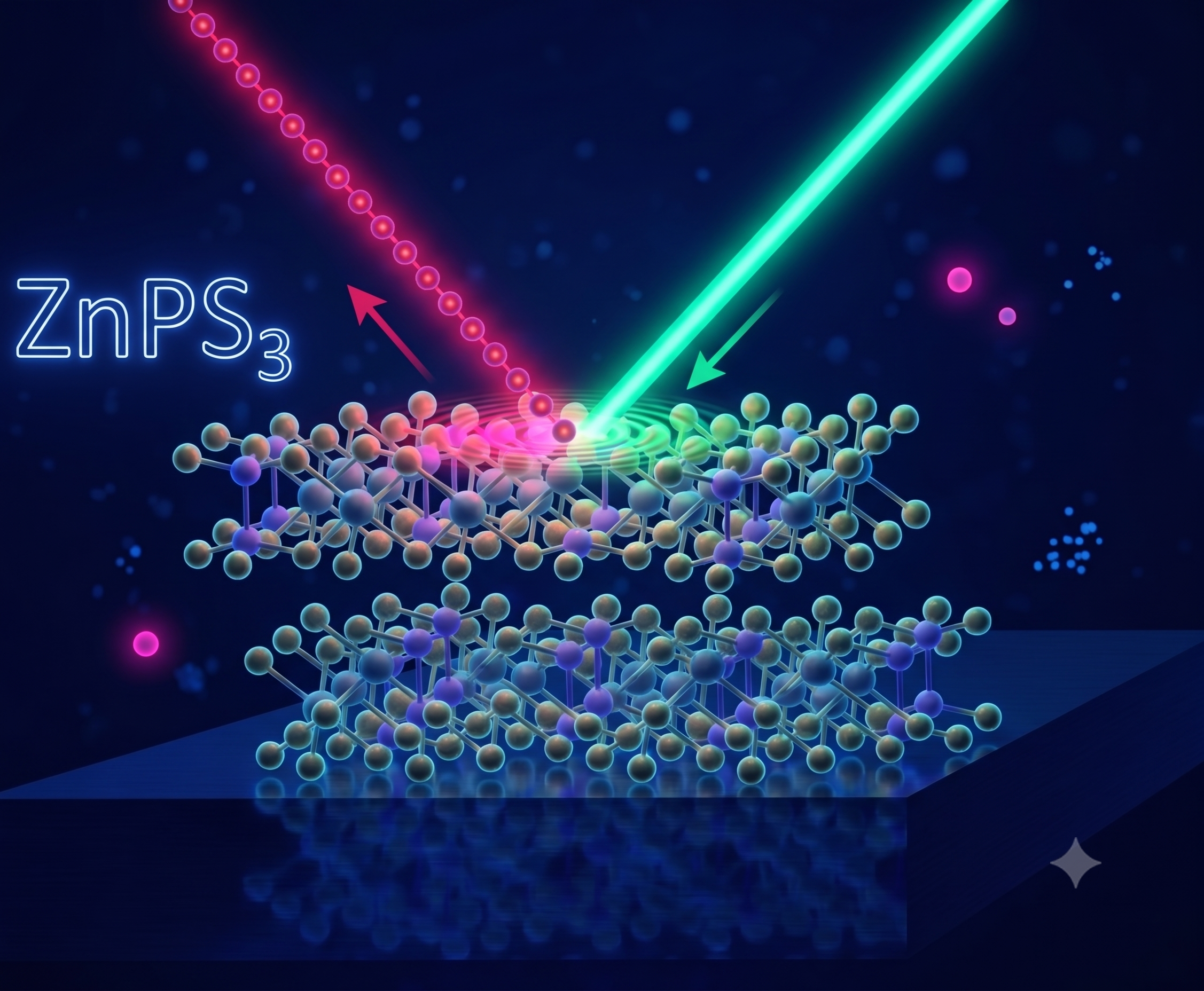
Layered ZnPS₃ crystal excited by a laser beam emits a stream of single photons. (Visualization created by Natalia Zawadzka, using artificial intelligence, Faculty of Physics University of Warsaw).
Single-photon emitters are point sources capable of generating exactly one particle of light on demand. They are intensively sought after for optical quantum technologies, such as quantum cryptography and quantum information processing. Traditional systems of this type, based on quantum dots or color centers in diamond, are in many respects inferior to a new class of materials: two-dimensional van der Waals layered crystals. Unlike bulk materials, 2D crystals can be easily transferred and precisely placed onto almost any substrate without the constraints of lattice matching. This feature allows for their seamless integration with existing miniature photonic circuits, silicon chips, and optical fibers. In practice, this enables the creation of complex, multi-component optical circuits on a single chip. Consequently, these materials provide a highly promising platform for future scalable quantum architecture, paving the way for the mass production of integrated quantum processors.
As part of this pioneering research, thin flakes of zinc phosphorus trisulfide (ZnPS₃), belonging to the family of layered metal phosphorus trichalcogenides (MPX₃), were investigated. This material is a wide-bandgap semiconductor with a bandgap of approximately 3.63 eV. The study focused on thin flakes of the material with thicknesses on the order of several dozen nanometers and several dozen micrometers in diameter. A key element of the work is the identification of the microscopic mechanism responsible for the single-photon emission, as well as the investigation of their physical properties. The source of the quantum emission may be structural defects in the crystal lattice, specifically single phosphorus atom vacancies. This hypothesis is supported by the theoretical calculations presented in the article. Upon exciting the material with laser light, the point defect in the crystal lattice generates an ordered stream of photons. The emitted photons exhibit a high degree of polarization, meaning they possess a strictly defined and stable spatial orientation of their electromagnetic wave. This property can be utilized in quantum cryptography, where information can be encoded through the polarization direction of individual light particles.The research was funded by the National Science Centre, Poland, under the SONATA BIS project "Hybrid structures of layered materials for modern optoelectronics" (principal investigator: dr hab. Maciej Molas, prof. UW; grant no. 2022/46/E/ST3/00166), carried out at the Faculty of Physics, University of Warsaw.
Faculty of Physics at the University of Warsaw
Physics and astronomy at the University of Warsaw appeared in 1816 as part of the then Faculty of Philosophy. In 1825, the Astronomical Observatory was established. Currently, the Faculty of Physics at the University of Warsaw consists of the following institutes: Experimental Physics, Theoretical Physics, Geophysics, the Department of Mathematical Methods in Physics. The research covers almost all areas of modern physics on scales from quantum to cosmological. The Faculty's research and teaching staff consists of over 250 academic teachers. About 1350 students and over 150 doctoral students study at the Faculty of Physics UW. The University of Warsaw is among the 200 best universities in the world, educating in the field of physics according to Shanghai’s Global Ranking of Academic Subjects.
SCIENTIFIC PUBLICATION:
Natalia Zawadzka, Dmitrii Litvinov, Stan Kwast, Denis Baranov, Malte Rösner, Maciej R. Molas, Maciej Koperski, Magdalena Grzeszczyk, Defect-Induced Single-Photon Emission in ZnPS₃ , ACS Nano, Vol 20/Issue 25
https://pubs.acs.org/doi/10.1021/acsnano.5c19936
CONTACT:
Mgr Natalia Zawadzka
Faculty of Physics, University of Warsaw
Natalia.Zawadzka@fuw.edu.pl
Dr. hab. Maciej Molas, Professor of the University of Warsaw
Faculty of Physics, University of Warsaw
phone +48 22 55 32 721
maciej.molas@fuw.edu.pl
RELATED WEBSITES WWW:
https://www.fuw.edu.pl
Website of the Faculty of Physics, University of Warsaw
https://www.fuw.edu.pl/press-releases.html
Press service of the Faculty of Physics, University of Warsaw
GRAPHIC MATERIALS:
FUW260630b_fot01
https://www.fuw.edu.pl/tl_files/press/images/2026/FUW260630b_fot01.png
Layered ZnPS₃ crystal excited by a laser beam emits a stream of single photons. (Visualization created by Natalia Zawadzka, using artificial intelligence, Faculty of Physics University of Warsaw).