


Alloy-engineered valleytronics
2026-02-20
Scientists from the Faculty of Physics at the University of Warsaw, in collaboration with teams from the Wrocław University of Science and Technology, Sapienza University of Rome, University of Central Florida, Laboratoire National des Champs Magnétiques Intenses, National University of Singapore, CNR-IFN, as well as research centers in the Czech Republic (University of Chemistry and Technology, Prague) and Japan (National Institute for Materials Science), have observed a new microscopic mechanism enabling precise control of the magneto-optical properties of excitons in alloys of two-dimensional semiconductors. This discovery opens up tangible prospects for technological applications in devices exploiting valleytronics. The research findings were published in the prestigious journal “Physical Review Letters”.

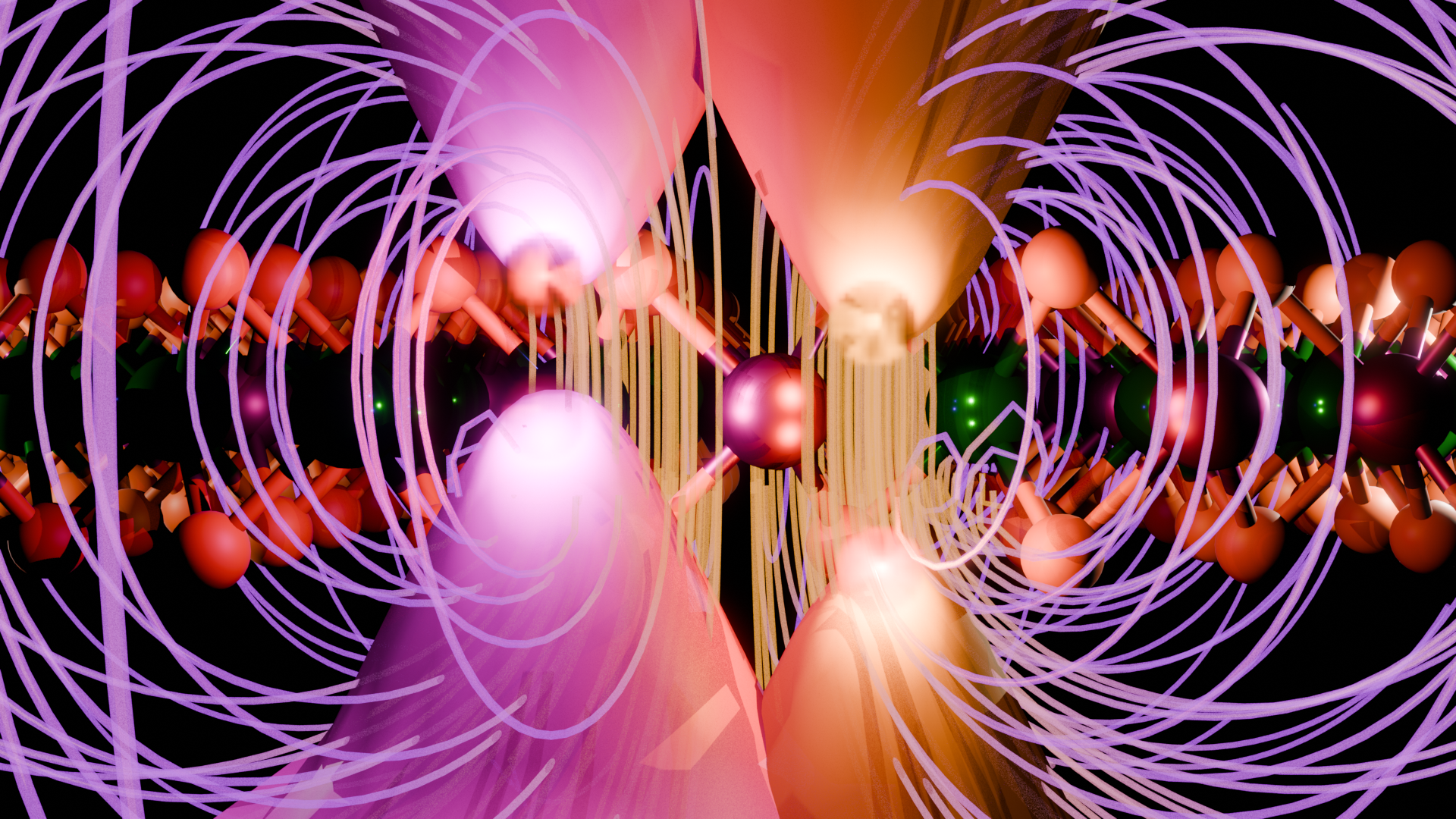
A monolayer of the transition metal dichalcogenide alloy MoWSe₂ with K⁺ and K⁻ valleys. The purplelines indicate the external magnetic field, the application of which leads to the splitting of exciton stateenergies as a result of the Zeeman effect. This phenomenon is illustrated as different separationsbetween the valence band and the conduction band in the two valleys. (Source: Grzegorz Krasucki,Faculty of Physics, University of Warsaw).
The 2010 Nobel Prize in Physics, awarded for groundbreaking experimental techniques enabling the isolation and investigation of graphene, stimulated broad interest in layered materials within the condensed-matter physics community. Their thickness-dependent properties continue to fascinate researchers, opening the door to new and potentially novel and promising applications. For many years, scientists from the Faculty of Physics, University of Warsaw have been actively contributing to the understanding of these materials. In collaboration with teams from the Wrocław University of Science and Technology, Sapienza University of Rome, University of Central Florida, Laboratoire National des Champs Magnétiques Intenses, National University of Singapore, CNR-IFN, as well as research centers in the Czech Republic(University of Chemistry and Technology, Prague) and Japan (National Institute for Materials Science), they have observed a new microscopic mechanism enabling precise control of the magneto-optical properties of excitons in alloys of two- dimensional semiconductors. The research findings were published in the prestigious journal “Physical Review Letters”.
Excitons, that is bound electron-hole pairs in solids, determine the optical properties of two-dimensional (2D) layered materials, in particular monolayers of semiconducting transition metal dichalcogenides. When an external magnetic field is applied perpendicular to the plane of a monolayer, the energy levels of excitons associated with inequivalent valleys of the first Brillouin zone undergo splitting. This phenomenon is known as the excitonic Zeeman effect. The Zeeman effect lifts the energy degeneracy of emission lines corresponding to exciton recombination with two opposite circular polarizations (so-called right- and left-handed polarizations, σ⁺ and σ⁻). Experimental observation of this splitting in an external magnetic field enables the determination of the exciton g-factor, a key parameter describing the magnitude of the exciton magnetic moment in a magnetic field. This parameter is closely related to the electronic band structure of the semiconductor and to spin–valley coupling in 2D materials.
As part of this study, high-quality monolayers of mixed alloys Mo x W 1-x Se 2 with precisely controlled chemical composition were investigated. The samples were synthesized in the Czech Republic and encapsulated between flakes of hexagonal boron nitride fabricated in Japan. For a series of samples with varying molybdenum and tungsten content, systematic photoluminescence measurements were carried out at a temperature of 10 kelvin and in strong magnetic fields reaching up to 30 tesla at the Laboratoire National des Champs Magnétiques Intenses in Grenoble. An analysis of the emitted light in circular polarizations enabled highly accurate determination of the neutral exciton g-factor.
The obtained results reveal a strong and nonlinear dependence of the exciton g- factor on the chemical composition of the alloy. While the g-factor in both MoSe 2 and WSe 2 monolayers is close to −4, it undergoes a dramatic change in the mixedmaterial, reaching very high values of approximately −10 for alloys containing about 20% Mo. Such a wide tuning range of the exciton g-factor has not been previously observed in these monolayers. Comparable values had earlier been achieved only in complex moiré heterostructures, which require precise alignment of stacked layers. “In our publication, we demonstrated that for transition metal dichalcogenide alloys, controlling the chemical composition of a monolayer is sufficient to achieve this goal,” explains MSc Katarzyna Olkowska-Pucko, a PhD student at the Faculty of Physics of the University of Warsaw and the first author of the paper, published in Physical Review Letters.
A key element of this work is the identification of the microscopic mechanism responsible for the observed effect. The combination of magneto-optical measurements and ab initio density functional theory (DFT) calculations revealed that the nonlinear modulation of the exciton g-factor originates from mixing of conduction-band states between the K and Q valleys, induced by local alloy inhomogeneity. In addition, it was shown that mechanical strain can further enhance this effect.
This discovery opens up real prospects for technological applications in devices that use valleytronics. It is a field of condensed matter physics that utilizes so-called “valleys” - energy extrema in the band structure of semiconductors (e.g., transition metal dichalcogenides) to encode and process information. Compared to conventional devices based on charge or spin, valleytronics offers lower energy consumption and greater computational efficiency, enabling the development of new information technologies.
The discovered mechanism is general in nature and opens a new research direction that can be described as alloy-engineered valley physics (or valleytronics). “It provides a simple and scalable approach to controlling the magneto-optical properties of two-dimensional materials. Moreover, it enables the encoding, processing, and readout of information in selected K⁺ and K⁻ valleys using light polarization. Importantly, very large exciton g-factors lead to strong valley splitting at relatively low magnetic field, enabling realistic technological applications in valleytronic devices”, explains Prof. Maciej Molas, researcher at the Faculty of Physics, University of Warsaw.”
This research was funded by the National Science Centre under the OPUS” Excitonic complexes in two dimensional van der Waals structures” (Principal Investigator: dr hab. Maciej Molas, University Profesor, nr 2018/31/B/ST3/02111) and the PRELUDIUM “Optical properties of monolayers of transition metal dichalcogenide alloys” project (Principal Investigator: M.Sc. Katarzyna Olkowska-Pucko, nr 2022/45/N/ST3/01887), carried out at the Faculty of Physics, University of Warsaw. The realization of this research project was also supported by access to high magnetic fields, funded within the Polish Ministry of Science and Higher Education project “EMFL+ Poland” (Principal Investigator: prof. dr hab. Adam Babiński; project no. 2025/WK/01).
Faculty of Physics at the University of Warsaw
Physics and astronomy at the University of Warsaw appeared in 1816 as part of the then Faculty of Philosophy. In 1825, the Astronomical Observatory was established. Currently, the Faculty of Physics at the University of Warsaw consists of the following institutes: Experimental Physics, Theoretical Physics, Geophysics, the Department of Mathematical Methods in Physics. The research covers almost all areas of modern physics on scales from quantum to cosmological. The Faculty's research and teaching staff consists of over 250 academic teachers. About 1350 students and over 150 doctoral students study at the Faculty of Physics UW. The University of Warsaw is among the 200 best universities in the world, educating in the field of physics according to Shanghai’s Global Ranking of Academic Subjects.
SCIENTIFIC PUBLICATION:
Katarzyna Olkowska-Pucko, Tomasz Woźniak, Elena Blundo, Natalia Zawadzka, Łucja Kipczak, Paulo E. Faria Junior, Jan Szpakowski, Grzegorz Krasucki, Salvatore Cianci, et al., Extremely High Excitonic g- Factors in 2D Crystals by Alloy-Induced Admixing of Band States, Phys. Rev. Lett. 136, 076901, 17 February, 2026
https://doi.org/10.1103/lx4n-7bb7
CONTACT:
Dr. hab. Maciej Molas, Professor of the University of Warsaw
Faculty of Physics, University of Warsaw
tel. +48 22 55 32 721
maciej.molas@fuw.edu.pl
MSc Katarzyna Olkowska-Pucko
Faculty of Physics, University of Warsaw
tel. +48 22 55 32 709
Katarzyna.Olkowska-Pucko@fuw.edu.pl
RELATED WEBSITES WWW:
https://www.fuw.edu.pl
Website of the Faculty of Physics, University of Warsaw
https://www.fuw.edu.pl/press-releases.html
Press service of the Faculty of Physics, University of Warsaw
GRAPHIC MATERIALS:
FUW260220b_fot01
https://www.fuw.edu.pl/tl_files/press/images/2026/FUW260220b_fot01.png
A monolayer of the transition metal dichalcogenide alloy MoWSe₂ with K⁺ and K⁻ valleys. The purplelines indicate the external magnetic field, the application of which leads to the splitting of exciton stateenergies as a result of the Zeeman effect. This phenomenon is illustrated as different separationsbetween the valence band and the conduction band in the two valleys. (Source: Grzegorz Krasucki,Faculty of Physics, University of Warsaw).