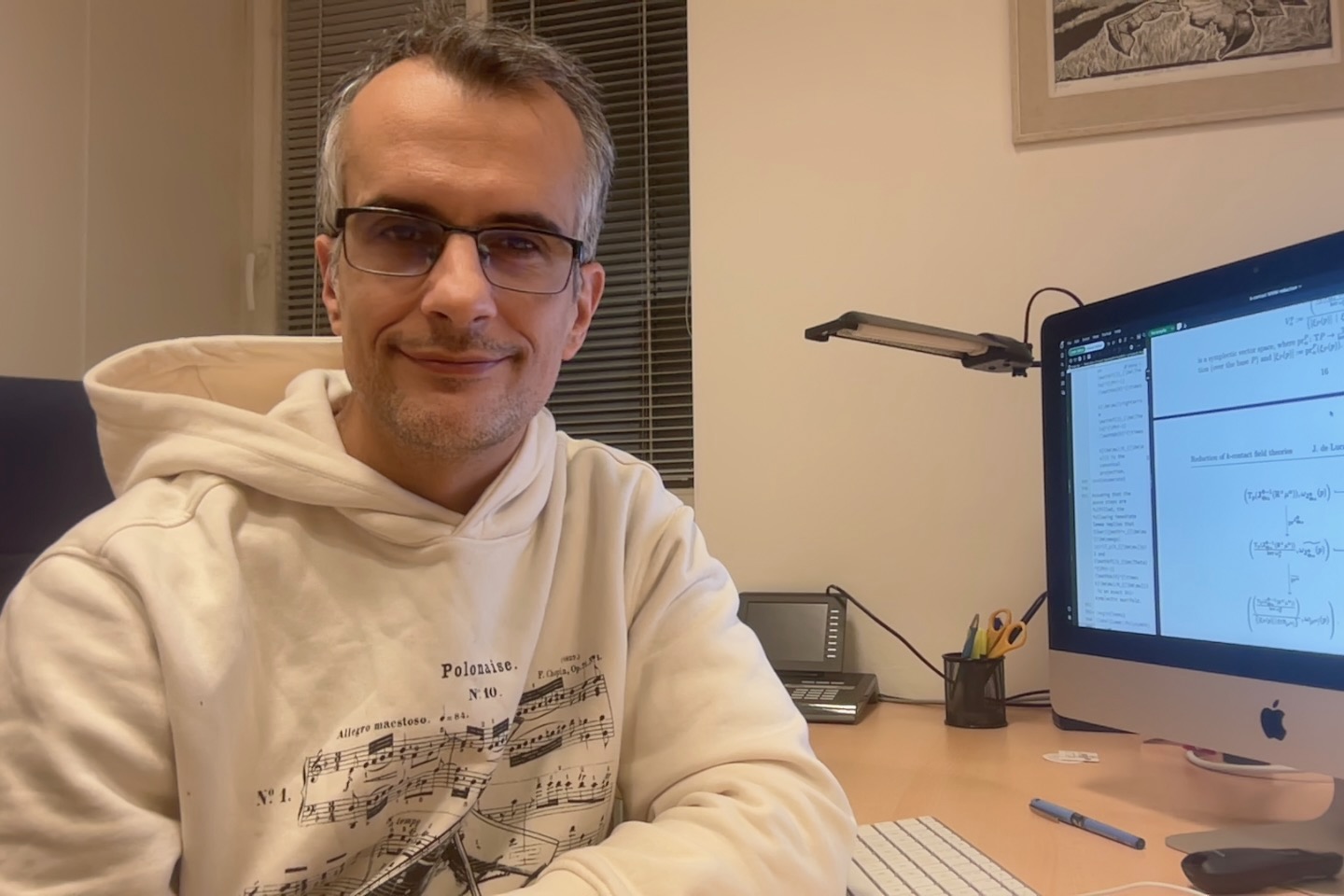
Gamma Research Group Program
GAMMA (Geometry and Applications: Modern Mathematical Approaches) is both a research group and a formation environment for students, doctoral, and postdoctoral researchers. Gamma has a seminar whose talks and lecture series are publicly available on YouTube and can be used for independent study.
Student formation and early research experience
What students do in Gamma
- Join seminars and reading groups from early stages (BSc/MSc).
- Learn modern geometric methods through guided projects and collaborative work.
- Present progress in internal seminars and give short talks.
- Participate in student conferences and deliver presentations at early stages.
- In selected cases, develop results that may lead to co-authored publications, when warranted by scientific maturity and opportunity.
Standards
Publication is not treated as a routine target. When it happens, it is the outcome of genuine progress, appropriate timing, and rigorous quality control.
English
Research profile and academic activities of prof. Javier de Lucas Araujo
I am a mathematician working at the interface between differential geometry and mathematical physics, currently affiliated with the Faculty of Physics, University of Warsaw and related to the Centre de Recherches Mathematiques of the Unviersity of Montreal. Alongside my individual research, I actively lead a research group composed of undergraduate students, PhD candidates, and early-career researchers, with whom I collaborate on both foundational and applied problems in geometric mechanics.
My scientific work focuses on symplectic, Poisson, cosymplectic, and Dirac geometry, as well as their extensions to multi-time and field-theoretical frameworks, including k-symplectic and k-contact geometry. A central theme of my research is the development of geometric reduction theories, geometric methods for differential equations, and their applications to classical mechanics, field theories, and gauge-type systems.
An important part of my activity is the leadership of the Gamma Geometric Mechanics Program, which serves not only as a research platform but also as a training and formation environment for students and doctoral researchers. Within Gamma, students are gradually introduced to modern geometric methods, learn how to read and write research-level mathematics, and actively participate in seminars and collaborative projects.
Within Gamma, particular emphasis is placed on the early scientific development of students. Already at undergraduate and early graduate stages, students are encouraged to participate in the academic community by presenting their work at student conferences, giving seminar talks, and contributing to research discussions. In selected cases, when the scientific maturity of the results justifies it, such activities may naturally lead to co-authored research publications. These outcomes are not treated as routine objectives, but rather as the result of genuine scientific progress and appropriate opportunities.
A distinctive feature of Gamma is its open and educational character: many seminars and lecture series are publicly available on YouTube, allowing students and young researchers to learn geometric mechanics independently and at their own pace. These materials are regularly used as complementary resources for advanced courses and PhD training.
My publications appear in international journals in geometry and mathematical physics and often result from close collaboration with members of my research group. I place strong emphasis on mentoring, long-term scientific formation, and building bridges between abstract geometric theory and concrete physical models.
Polski
Profil naukowy i działalność badawczo-dydaktyczna
Jestem matematykiem zajmującym się geometrią różniczkową i fizyką matematyczną, związanym z Wydziałem Fizyki Uniwersytetu Warszawskiego. Oprócz własnej działalności naukowej prowadzę aktywną grupę badawczą, w skład której wchodzą studenci, doktoranci oraz młodzi badacze, wspólnie realizujący projekty z zakresu geometrii mechaniki i teorii pól.
Moje zainteresowania obejmują geometrię symplektyczną, Poissona, kosymplektyczną oraz struktury Diraca, a także ich uogólnienia do kontekstów wieloczasowych i polowych, takich jak geometria k-symplektyczna i k-kontaktowa. Istotnym nurtem moich badań są teorie redukcji geometrycznej, metody geometryczne w teorii równań różniczkowych oraz ich zastosowania w mechanice klasycznej i teoriach typu cechowania.
Kluczowym elementem mojej działalności jest kierowanie programem Gamma – Geometric Mechanics, który pełni jednocześnie rolę platformy badawczej oraz środowiska formacyjnego dla studentów i doktorantów. W ramach Gamma młodsi uczestnicy stopniowo uczą się nowoczesnych metod geometrycznych, pracy z literaturą naukową oraz samodzielnego prowadzenia badań.
W ramach Gamma szczególny nacisk kładziony jest na wczesną formację naukową studentów. Już na etapie studiów licencjackich i magisterskich studenci są stopniowo włączani w działalność naukową poprzez udział w konferencjach studenckich, wygłaszanie referatów oraz aktywny udział w seminariach i dyskusjach badawczych. W wybranych przypadkach, gdy poziom merytoryczny uzyskanych wyników na to pozwala, taka aktywność może prowadzić również do współautorstwa publikacji naukowych. Nie jest to jednak traktowane jako cel sam w sobie, lecz jako naturalna konsekwencja rzeczywistego postępu badawczego i sprzyjających okoliczności.
Ważną cechą programu Gamma jest jego otwarty i dydaktyczny charakter: liczne seminaria i wykłady są publicznie dostępne na YouTube, dzięki czemu studenci mogą uczyć się geometrii mechaniki także samodzielnie, poza formalnymi zajęciami. Materiały te są regularnie wykorzystywane jako uzupełnienie kursów zaawansowanych oraz kształcenia doktorantów.
Moje publikacje ukazują się w międzynarodowych czasopismach z zakresu geometrii i fizyki matematycznej i często powstają we współpracy z członkami grupy badawczej. Szczególną wagę przykładam do długofalowej formacji młodych naukowców oraz do łączenia abstrakcyjnej teorii geometrycznej z konkretnymi modelami fizycznymi.
CRM collaboration
- I am a external member of the Centre de Recherches Mathématiques (CRM) at the University of Montreal, within the Mathematical Physics and Geometry research group.
- The CRM is a leading mathematical research institute in Canada, fostering collaboration among mathematicians from various fields and institutions.
- Through this affiliation, I engage in joint research projects, seminars, and workshops with fellow researchers in geometry and mathematical physics.
- This collaboration, started in 2015 under a HARMONIA project of the Polish NCN, enriches my research activities and provides valuable opportunities for my students to connect with the broader mathematical community. It has been instrumental in fostering international collaborations and enhancing the research profile of my group. In particular, it led to a second HARMONIA project (2019-2023) as well as a CRM-Simons professorship for prof. J. de Lucas in 2023.
Links
- Gamma seminar YouTube channel: GammaSeminar
- Gamma seminar website: fuw.edu.pl/KMMF/gamma
- Main website: /~delucas/
- Detailed CV (PDF): Curric-Eng.pdf