Looping Network Meetings
#84 May 4, 2026
Monday 15:00 (Paris/Warsaw time)
Eric Herbert (LIED Université Paris Cité)
From local rules to global network: the case of Podospora anserina
Abstract:
How does a filamentous organism, originating from a single spore, autonomously construct a connected, dense, and functional network from a small set of elementary local rules? The model organism that has enabled this question to be addressed is the filamentous fungus Podospora anserina, whose thallus—a network consisting of an entanglement of tubes known as hyphae—exhibits the distinctive feature of growing without symbiosis, and therefore without external interaction.
From a physical standpoint, Podospora anserina offers the opportunity to investigate a branching, static, connected, and growing network, from the initial spore to the establishment of a dense network, according to three simple rules: polarised growth at the tips, branching (apical or lateral), and fusion (anastomosis) of an apex onto a pre-existing hypha. This parsimony of local rules makes modelling tractable with a reduced number of parameters, while nonetheless giving rise to remarkable topological complexity.
https://dyco.lied.univ-paris-diderot.fr/ANR_NEMATIC/
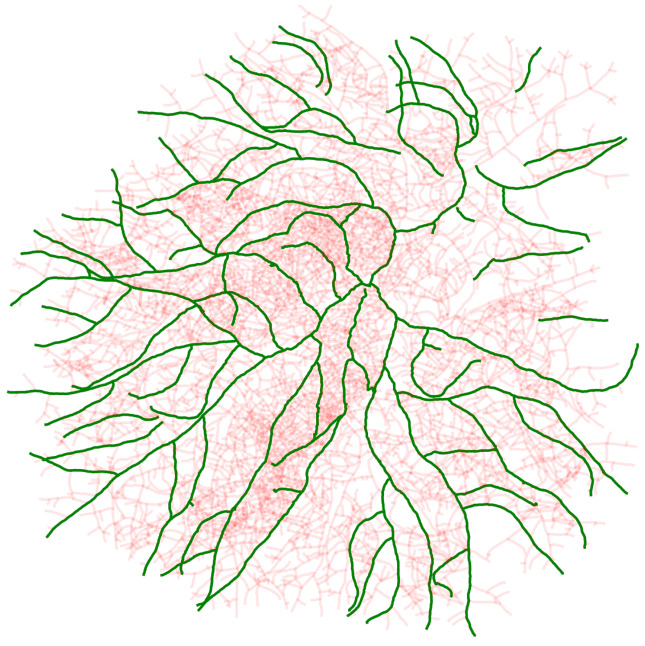
Image source: LIED
Head image credits (from top left):
(1) Corentin Bisot and Loreto Oyarte Galvez,
(2) Claire Lagesse,
(3) Stéphane Douady,
(4) Stanisław Żukowski,
(5) Przemysław Prusinkiewicz,
(6) Andrea Perna,
(7) John Shaw (Google Earth),
(8) Justin Tauber,
(9) Marc Durand.
Contact: s.zukowski [at] uw.edu.pl