Looping Network Meetings
#85 May 18, 2026
Monday 15:00 (Paris/Warsaw time)
Giulio Facchini (Laboratoire Matière et Systèmes Complexes, CNRS, Université Paris Cité)
Deciphering the origin of saddle-shape geometry in the microstructure of echinoderms skeleton.
Abstract:
The microstructure of echinoderms skeleton, like sea stars and sea urchins, is an impressive example of self-organization and complexity. This structure called stereom is a porous meshwork, made of calcite, whose surface is saddle-shaped, and remind of minimal surfaces. Minimal surfaces have intrigued scientists for centuries, as they can spontaneously emerge from minimizing interfacial energy like surface tension. Several studies have addressed the morphogenesis of the stereom, in sea urchins and other echinoderms, showing that it forms via the addition of tiny mineral bids at the tip of small skeletal elements that successively branch and bridge to form a complex network. Yet, a global, mechanistic, comprehension of how biomineralizing cells control preferential deposition is still lacking.
During the seminar I will present a recent work on the morphogenesis of the particular stereom geometry observed in the sea star P. nodosus. Here, the stereom can take the form of a diamond Triply Periodic Minimal Surface (TPMS) which confer it specific mechanical properties. Using different marking protocols, we provide the first experimental insight in the formation of the diamond TPMS stereom, and show that the formation of such a highly ordered structure relies on a precise and timely coordination of the branching and bridging episodes. Moreover, we provide experimental evidences of an organic precursor made of F – actin fibers exhibiting saddle-shape geometry. We hypothesise that such a fibers template may self-organise under mechanical tension, thus explaining the peculiar curvature signature of the final structure. Finally, I will present some ongoing experimental work performed on sea urchins, showing that the same morphogenetic mechanism could be shared across very different species.
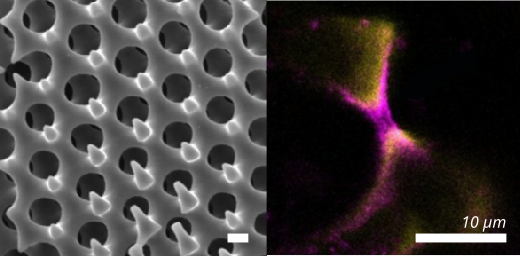
Image source: Electron microscopy and Confocal microscopy (scale bar 10 micron)
Head image credits (from top left):
(1) Corentin Bisot and Loreto Oyarte Galvez,
(2) Claire Lagesse,
(3) Stéphane Douady,
(4) Stanisław Żukowski,
(5) Przemysław Prusinkiewicz,
(6) Andrea Perna,
(7) John Shaw (Google Earth),
(8) Justin Tauber,
(9) Marc Durand.
Contact: s.zukowski [at] uw.edu.pl